Hi everybody!
Melvin here, back for his second Xform blog. This time I'm going
to tell you kids about the creation of music in games, with a small part of
history in game music.
All games authoring software support wav. Most of them also
support pre-compressed audio files, such as mp3 and ogg vorbis. UDK however only
imports 16 bit WAV files, but compresses them internally using OGG compression
with the ability to tweak the quality/size ration. Unity3D on the other hand
almost imports all audio imaginable and also has the built-in option to
compress audio files (OGG) with quality options.
When considering music one of the first question you'll have
to ask yourself is:
What do you want to do with your music?
Do you just want background music, which plays and loops
till the next level start? In that case we're talking about linear music. Next
to studio recordings of music with real vocalists and musicians, we also have music
created with DAW (Digital Audio
Workstation) software such as Logic Pro,
Propellerhead Reason, Ableton Live, FL Studio. And it's somehow still more obvious in the
gaming industry than using recordings. I myself am a big fan of Propellerhead
Reason.

I've been using it for 12 years now and all the music I
composed for Xform are created with Reason, including the first Burnin'
Rubber (2006) track "Alpha Beta", which was
remixed for Burnin' Rubber 2 in 2008. This definite version is also heard
in the latest, Burnin' Rubber 5.
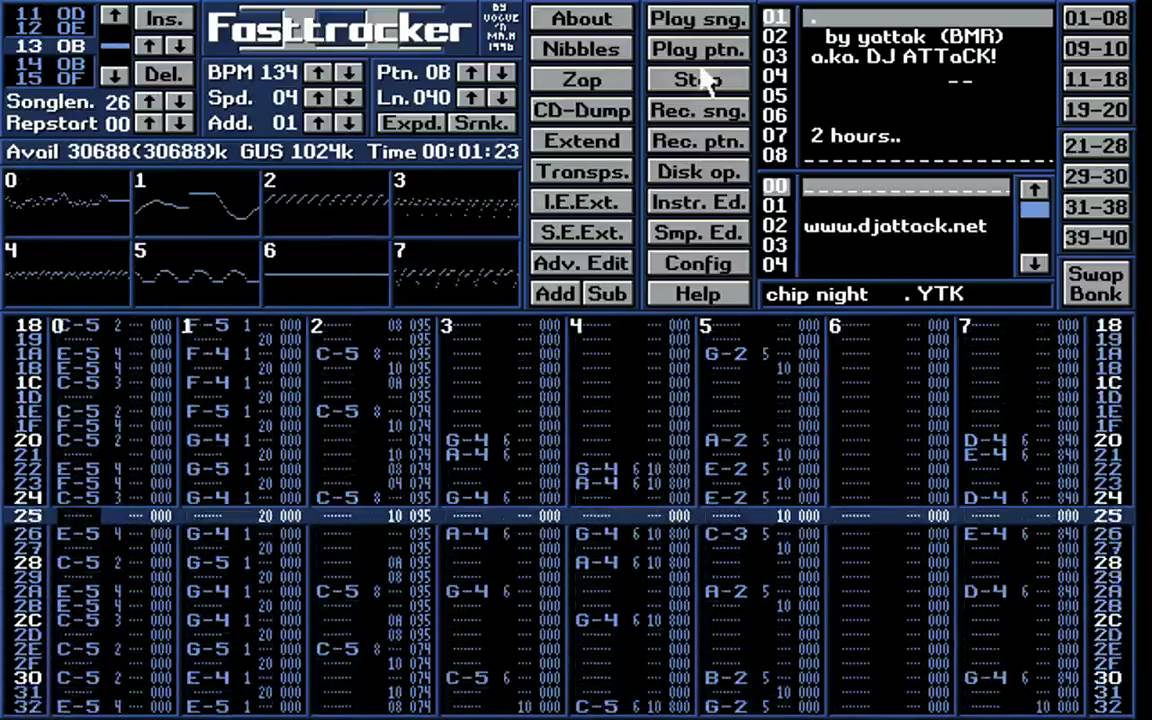
Before Reason, I used Fasttracker 2, a tracker
program for DOS to make music modules (mod). Mod was a format that
originated from the demo scene in late eighties. Next to MIDI this was a format
that was frequently used in games because the files were very small yet
relatively high in fidelity, until mp3 compression became popular. Other games
used music that was on the audio section of the CD-ROM.
Interactive soundtrack
Do you want more complex event triggered music. Layers of
sound fading in and out. Or seamlessly cross fade between a level soundtrack
and a boss soundtrack? In that case it's possible you'll be composing something
that will never sound the way you initially created it, because the player is semi
in charge of the composition.
All major engines (Unreal
3, CryEngine and Unity3D) have FMOD integration. FMOD
is middleware for managing interactive sound and music. I haven't done much
with it myself. And here at Xform most of the music composed here
is for linear use. If there is a demand for interactive music at Xform
I'd probably check FMOD out, because of the integration in Unity3D. Other interactive sound middleware are for example Miles from Rad Game Tools and Audiokinetic Wwise.
The only project where I created an interactive soundtrack was
my own graduation game project back in 2005. I composed the song in Reason,
then chopped it in segments and used these segments in a tracker (see Fasttracker 2 above) to create a mod
with 52 separate channels. Events in the game activated or deactivated channels,
which resulted in a varied soundtrack consisting of a nice blend of
instruments. This is one of the simplest form of interactive music, which is
also used in classics such as Super Mario World (when Mario rides on Yoshi's back).
In my next blog I'm going to write about composing in Reason
and you'll be hearing music excerpts of a new Xform game.
Till next time!
Melvin